
Deep cut
Monday, October 26, 2026
The White Mountains of Ambler - the asbestos town and the hills it left behind
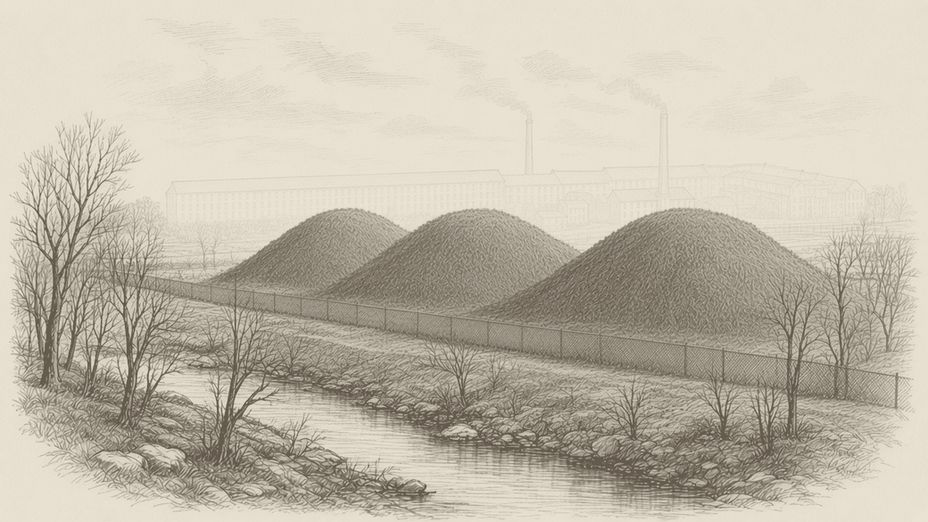
Not far from Butler Avenue in Ambler, along the Wissahickon, there are some steep green hills behind a fence that look way too tall for the flat ground around them. People in Ambler called them the White Mountains.
Not far from Butler Avenue in Ambler, along the Wissahickon, there are some steep green hills behind a fence that look way too tall for the flat ground around them. People in Ambler called them the White Mountains. They're asbestos waste, about 1.5 million cubic yards of it, and they explain more about Ambler than any plaque downtown.
I think every neighbor should know this one, because the company that left those hills also built a big piece of the Ambler you like.
A village on the railroad
Before asbestos, Ambler was a small mill town on the railroad, and by 1880, the Science History Institute's magazine says, the mills had closed or were losing money. Even the name came from the railroad. In 1869 it renamed its Wissahickon station for Mary Johnson Ambler, who cared for the injured after an 1856 train wreck nearby, per the publisher's description of Frank Quattrone's Arcadia history of Ambler.
Then came Keasbey & Mattison
Keasbey & Mattison was a Philadelphia company that started out selling patent medicines. Dr. Richard Mattison figured out that asbestos could be turned into insulation for steam pipes, and in the early 1880s he moved the business to Ambler. The railroad was the draw, since trains could bring asbestos down from Quebec. The EPA's background page adds that K&M made pharmaceuticals like Milk of Magnesia alongside its asbestos products.
The plant made everything from pipe covering and theater curtains to roofing shingles. Mattison brought over stoneworkers and laborers from southern Italy, according to both the Times Herald and the Science History Institute. Then he ran Ambler like a company town. The Times Herald reported in 2015 that roughly 400 residences belonged to Mattison, from plain houses for factory workers to bigger homes for executives farther up Butler Avenue. Both the Times Herald and the historical society credit him with putting up Ambler's streetlights, and he paid for the library and the opera house.
For about three-quarters of a century, the Science History Institute wrote, Ambler was known as the asbestos-manufacturing capital of the world. E&E News used the same line in 2016.
How the hills got there
The EPA picks up the story from here. Dumping of asbestos waste on the Ambler property started in the 1930s. In 1962 K&M stopped operating, and CertainTeed and Nicolet Industries bought different parts of the site and kept making asbestos products and dumping the waste. CertainTeed stopped in 1974. Nicolet operated until at least October 1987, by then making only asbestos rubber gaskets.
EPA's 1994 "Superfund at Work" bulletin describes what that left on a 23-acre site in Ambler. There were more than 1.5 million cubic yards of contaminated waste in three huge piles, one as high as 70 feet, "still remembered by some local residents as, 'the white mountains'." About 6,000 people lived within half a mile, and the closest home sat 200 feet from the property line. There was a public playground on the site, on Locust Street. After scientists found asbestos fibers on the playground equipment in November 1983, EPA warned the community that the area was unsafe and the equipment was taken down. The bulletin says the playground closed in 1984.
What it cost
Workers in Ambler handled raw asbestos fiber with little protection. One retired resident told the Science History Institute that you'd sometimes see a guy with a handkerchief over his mouth, "but they didn't have respirators." Men brought the dust home on their clothes, and their wives washed it out, the Times Herald and the Science History Institute both report. Residents told both outlets that kids played on the piles. A lot of Ambler families lost people to asbestos-related illness, so this is the part of the story to read slowly.
Capping the mountains
EPA proposed the Ambler Asbestos Piles for its national Superfund list in October 1984 and made the listing final in June 1986. Its bulletin says hauling that much asbestos out of Ambler would have sent a huge amount of fibers into the air, so the waste stayed and got covered. Workers backfilled the old waste lagoons with clean soil and capped the two biggest piles with geotextile covers and crushed stone. A concrete blanket went along the creek bank to stop erosion. Trees and other plants now cover the three steep hills, the bulletin says.
Construction finished in 1993, and EPA took the site off the national list in December 1996. EPA still reviews it every five years, and the next review is expected in 2027.
A second Ambler site, BoRit, went on the national list in 2009. EPA's site page says BoRit's cleanup construction wrapped in 2018, and it's still on the list.
What Ambler did next
The old K&M Boiler House sat empty for years after the company was gone. In 2011 it got a $16 million renovation, partly backed by EPA brownfields money, and it's office space now, per both the Science History Institute and E&E News. Today Ambler is the restaurant-and-theater town you know, right next to green hills that are really what's left of the industry that built it.
How to see it
You can see the capped hills from public streets. They're fenced and posted, so stay outside the fence. If you want more, the Wissahickon Valley Historical Society in Blue Bell is the right next stop.
Myth check
- "They hauled the asbestos away." They didn't. EPA chose to cap it in place, and that's why the White Mountains look like grassy hills now.
- The Superfund year. You'll see 1983 and 1986. EPA's own site page settles it. The site was proposed in October 1984 and finalized in June 1986. 1983 is the year EPA's emergency team inspected the site and found fibers on the playground.
- When K&M arrived. You'll find 1881 (the historical society) and 1882 (the Times Herald, the Science History Institute and E&E News). EPA's 1994 bulletin says K&M began making asbestos products in Ambler in 1897. I'm going with "the early 1880s" for the move.
- How tall the piles are. EPA's 1994 bulletin says one pile was as high as 70 feet. Reporters who walked the site in 2015 and 2016 gave bigger numbers. I'm sticking with EPA's.
The short version
Those steep green hills by the Wissahickon in Ambler are the White Mountains, about 1.5 million cubic yards of asbestos waste from the factory that built a big part of the town. Keasbey & Mattison arrived in the early 1880s, and Mattison ended up owning roughly 400 homes and putting up the streetlights. EPA listed the piles in 1986, capped and planted them instead of trucking them out, and still checks on them every five years.